
How to Build a Personal Style That’s Actually Yours
You’ve seen them. The people who walk into a room and somehow look like the


By any reckoning, Stuart Epps has had an interesting career in the engine room of British music. His fingerprints can be found on some of its most defining records, across a landscape which has constantly evolved and shifted according to new tastes and emerging technology. It’s a business unrecognisable from the one he plunged into as a wide-eyed teenager.
Now, Epps is reflecting on the highs and lows of a life in rock, as he prepares to bring his acclaimed live show, Stuart Epps Working with Elton John and Other Legends, to Brighton’s Komedia on Mon 9 Feb. Brimming with insight and incredible stories, it’s an evening that promises to shine some light on how our cultural landscape was shaped.
It would be tempting to assume that figures like Epps arrived in music through some star-studded backstage connection or pre-ordained family tie. The reality is much more relatable. And all the more compelling for it. In 1967, at just fifteen years old, Epps left school and took his first job with Dick James – the man who made his fortune publishing The Beatles’ music. In those days, London was the focus of a global pop revolution, and that bustling office was its nerve centre.

He began with a junior’s humble tasks – running errands, handling sheet music, and learning to operate recording machinery. But what was routine to those inside looked, from the outside, like proximity to genius. Despite starting at the bottom, the talent swirling around him would soon sweep him onto an upward trajectory. Those corridors welcomed lots of aspiring musicians and songwriters alongside the established legends. Among them was a young Reginald Dwight. “He was pretty crazy, quite outlandish… even at that time,” Epps tells me. “But he was just one of the staff writers then.” The world, of course, would come to know him as Elton John.
For the uninitiated, the world of 1960s music publishing was one of heady possibilities and breakneck innovation. Sheet music, rather than recordings, had been the primary currency of musical success. Despite the charts being increasingly impacted by physical media, there was still a huge market for pages of staves. Epps recalls those early days: “What was selling in bucket loads was the Beatles… Everyone wanted to play From Me To You and Please Please Me.” His duties had him ferrying music to printers and organising the print runs that fuelled a nation picking out Beatles tunes on home pianos.
But times and roles quickly evolved. Epps’s curiosity and determination saw him moving rapidly from office boy to disc-cutter, then to studio assistant, and finally to engineer. “By the early 70s, I was handling a lot of Elton John’s business for DJM Records,” he reflects. That work led to moments as exhilarating as they were improbable: “I used to do everything to do with Elton’s career in those early days… even touring with him. The first time I went to America was as Elton’s assistant on a three-month tour of America. I was only 18!”
He witnessed firsthand the early rise of this music icon, from being around during the creation of albums like Empty Sky and Elton John, to taking an active role in the production of Tumbleweed Connection and Goodbye Yellow Brick Road.
It’s a point in his life that still brings a note of awe to his voice. He remembers the stratospheric change that surrounded him: the frenzied work, the towering talent, and the sense that the boundaries of music itself were being redrawn.
While many would have rested on such laurels, Epps was yet to hit his stride. His hunger to shape records rather than simply assist in their making only grew. “I had a stint in the studio, but I was much more interested in A&R and management and running the record company.” The next leap was Rocket Records – a venture born of collaborative spirit and ambition, founded by Elton John, his long-time lyricist Bernie Taupin, trusted producer Gus Dudgeon, and manager John Reid.

But the lure of creation pulled him back to the recording studio. A pivotal moment was when record producer Gus Dudgeon asked for help establishing a new, world-class facility. “He spent a million pounds building the Mill Studios. As soon as the studio started taking shape, I got into the idea of recording. Maybe it was time to start it all again.”
At The Mill, Epps honed his reputation, working with both established superstars and fresh-faced acts. “We started working with new artists, one of whom was Chris Rea.” The studio took centre stage for British rock’s golden age. Led Zeppelin guitarist Jimmy Page later acquired the studio, and Epps was tasked with delivering results for a steady parade of huge stars – including Bill Wyman, George Michael, and Cliff Richard.
Epps’s reach stretched far. He became a go-to hand for both technical wizardry and creative counsel, working with Page on soundtracks (including Death Wish II), engineering a tribute album to Led Zeppelin’s late drummer John Bonham, and later collaborating with Page’s bands The Firm, which also featured Bad Company’s singular vocalist Paul Rodgers.
After The Mill, Epps shifted base to Wheeler End Studios, continuing his work across pop and rock with the likes of Oasis and Robbie Williams. During this time, Epps experienced firsthand one of the fundamental truths of music: its restless, irrepressible change. He watched as digital technology transformed the studio, and as entire genres faded while others blossomed.
“In the old days, more musicians and artists would specialise… honing their craft, being single-minded. Now, with home recording equipment, there are more artists who do it all themselves. Unfortunately, it’s very, very difficult. I’m still learning, and I’ve been doing it 50 years now!”
Perhaps more crucially, Epps reflects on how the collaborative, sometimes combative, dynamic of bands has been eroded. “Friction makes great bands. That’s definitely what made Oasis…” Today he sees fewer young musicians willing to endure the struggle and self-discovery that being in a band demands. “Now it’s all single artists, there’s just less of that band dynamic.”
In 2026, no conversation about music is complete without AI and technology. Epps approaches the subject with curiosity and healthy scepticism. “Now you don’t have to do anything to make music. You just come up with an idea and a couple of words…” He’s experimented with AI-generated vocals and arrangements, and while the results are sometimes dazzling on a technical level, he believes audiences will always discern what’s real.
He recounts a recent project: tasked with replicating a “James Bond” style theme which had been generated. He came away convinced that, extraordinary as it was, the machine-made version fundamentally lacked soul. “It was like a £50,000 production… immaculate, with amazing singing, orchestra, and brass. But I hope my one had more humanity in it.” He acknowledges AI may be a useful production tool, akin to the samplers and drum machines that shook up music in the 1980s, but draws the line at artistry: “Some of the end results are bonkers… but you can always spot them.”
For Epps, the story of British music is also a story of place, both lost and found. He is saddened by the decline in grassroots places to see live shows, particularly the mid-sized clubs that once acted as crucibles for talent. But he’s pragmatic about the causes.
“Venues want to fill the room. They’re not prepared to put on a bunch of lads playing music no one’s ever heard of. They stick with what everyone knows. Tribute bands are massive.” If the analogy is blunt, it is born of disappointment; the rich tradition of nurturing new talent feels diminished.
Some of these reflections, stories, and insights have become the substance of his own live show. Far more than a lecture or rambling nostalgia trip, it is a personal journey through the personalities, mishaps, and sheer unpredictability packed into life in rock and roll.
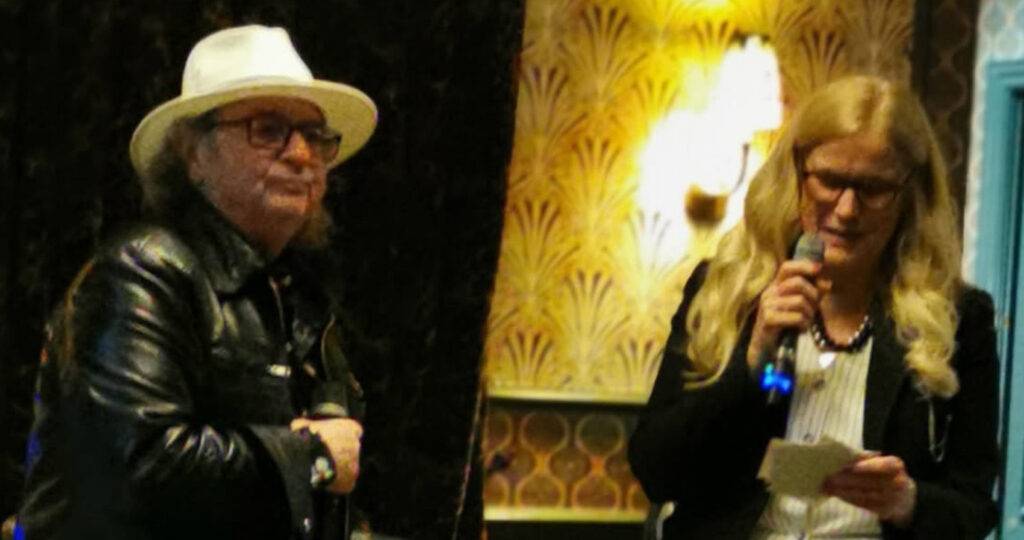
It’s like a living scrapbook. Epps curates dozens of photos, unseen video clips, and untold stories, charting his career from the Beatles’ publisher’s office to stadiums and studios across the planet. In the light of Chris Rea’s recent passing, the show also pays a heartfelt tribute to the journeyman singer/songwriter with Epps revealing a hidden side to this regular collaborator.
There are plenty of warm anecdotes. Epps recalls how legendary drummer Charlie Watts saw Chris Rea wearing overalls while he hung out at the studio, and after hearing him sing remarking that he had “a good voice for a plumber.”
Epps delights in these humanising moments, offering the audience not simply information but something closer to experience itself. “I try to make it funny, and obviously offer something about these artists that they didn’t know before.” After every show, he fields questions from the audience about artists he’s worked with, the recording process, or simply what it was like to be there when it happened.
For all the change, Epps believes success in music is still about drive, vision and the chemistry of personalities. “For anyone to succeed in the business, you’ve got to be of that personality… that dogged determination. These people, they have something to prove.” Elton John, he says, achieved greatness thanks not only to spectacular musical gifts but also an unwillingness to compromise. “Even though he didn’t look like any of his heroes, he wanted to be them. Once he started getting a taste, nothing was going to stop him.”
All the memories have coalesced in a show not only about what music has been, but what it could become. In a world obsessed by the new, we still hunger for meaning. Epps’s message is simple and powerful. Behind every song is a little bit of friction, plenty of passion, and a wealth of human experience.
Stuart Epps presents Working with Elton John and Other Legends at Brighton’s Komedia on Mon 9 Feb 2026.
Find out more at: www.stuartepps.co.uk
You’ve seen them. The people who walk into a room and somehow look like the

Authentically Historic Hideaways The Spaniards Inn Where: Spaniards Road, HampsteadWhat: Roaring fireplaces, classic ales, British
Nowadays, watching the right television shows seems to be integral to your social standing, and